
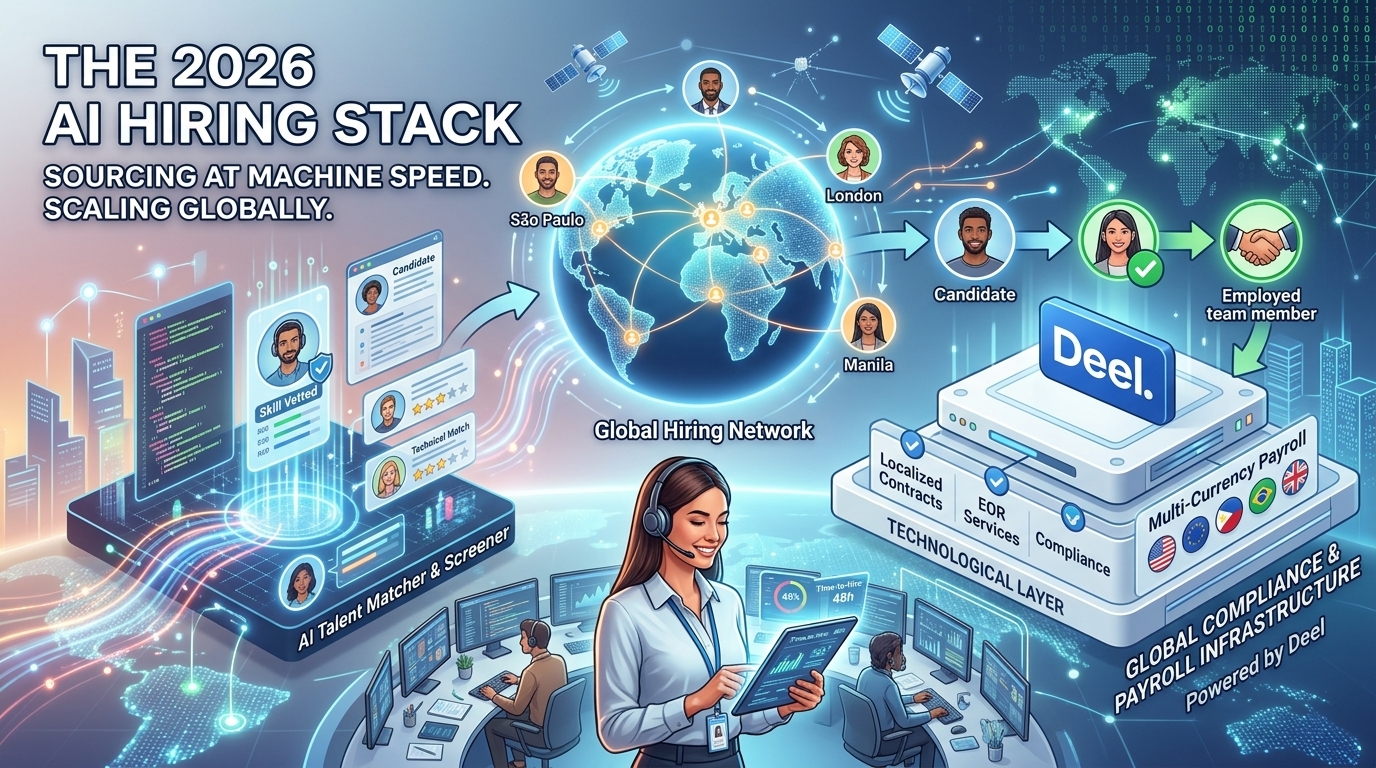

In 2026, the velocity of global recruitment has completely outpaced traditional human resources operations. Autonomous AI sourcing agents, real-time code evaluation systems, and generative interview screeners allow engineering managers, startup founders, and talent leaders to identify top 1% candidates across borders in minutes rather than months. Today’s hyper-growth startups no longer search within a 30-mile radius of their HQ—they recruit globally at machine speed.
However, an immediate operational paradox emerges: AI solves talent discovery, but infrastructure bottleneck remains. An autonomous recruiter can source, evaluate, and rank an elite machine learning developer in Brazil, Poland, or the Philippines within 48 hours. Yet, traditional operational workflows take three to six weeks to draft compliant localized contracts, set up foreign tax withholdings, navigate localized benefits, and dispatch pre-configured laptops.

To eliminate this friction and prevent candidate drop-off, modern companies are adopting the 2026 AI Hiring Stack—a four-layer operational blueprint anchored by Deel as the global compliance, payroll, and infrastructure execution engine.
Deconstructing the 2026 AI Hiring Stack
Building a borderless, high-velocity organization requires orchestrating multiple AI layers, culminating in a legal and financial infrastructure that operates as programmatically as code. Here is how leading technical teams structure their hiring workflow:
Layer 1: AI-Native Sourcing & Talent Discovery
Traditional job boards and passive sourcing are increasingly obsolete. Modern talent acquisition utilizes autonomous sourcing agents that continually crawl open-source repositories (like GitHub and Hugging Face), technical forums, dynamic portfolios, and localized professional databases. These AI tools evaluate passive candidates based on actual code quality, commit history, and domain specialization rather than superficial keywords on a resume.
Layer 2: Autonomous Technical & Soft-Skill Screening
Once identified, candidates interact with automated technical environments. LLM-driven screeners deliver complex architectural prompts, evaluate live pair-programming sessions, and grade both technical execution and communication nuances in real time. This ensures hiring managers only invest time in candidates who have demonstrated verified technical capability.
Layer 3: Orchestration & Candidate Experience
Cross-time-zone interview logistics, follow-ups, and background checks are fully automated by conversational AI workflows. Scheduling conflicts are dynamically resolved across 12+ time zones simultaneously, drastically reducing candidate ghosting and preserving high engagement throughout the recruitment lifecycle.
Layer 4: The Infrastructure Layer — Deel
The first three layers bring candidates to the offer stage at lightning speed. However, without a modern execution layer, legal and payroll bureaucracy halts momentum. Deel serves as the crucial foundation that converts candidates into legally employed, onboarded, and equipped team members anywhere on Earth within hours.

Why Deel is the Mandatory Operating System for Global Teams
When expanding globally, businesses face two options: spend months and tens of thousands of dollars setting up foreign legal entities, or partner with a global Employer of Record (EOR) and payroll provider. For detailed evaluation of EOR models vs localized hiring, read our guide on managing global teams in reality.
Deel provides the software infrastructure needed to execute hyper-fast global hiring while automating compliance risk:
- Continuous Compliance Engine (150+ Countries): Labor laws change constantly across different jurisdictions. Deel automatically generates localized employment agreements, statutory benefits packages, and tax documents compliant with local statutes. To understand how Deel simplifies complex international markets like North America, explore our US hiring payroll and compliance guide.
- Global Employer of Record (EOR): Hire full-time employees legally in minutes without registering local entities. Deel acts as the legal employer of record, taking on complete HR, legal, and regulatory liability. Check out our comprehensive Deel review for a breakdown of these features.
- Automated Contractor Management: Misclassifying independent contractors can lead to massive regulatory fines. Deel’s AI-driven classification engine mitigates misclassification risks automatically.
- Multi-Currency One-Click Payroll: Fund global payroll in your preferred base currency while employees receive localized direct deposits or multi-currency payout options seamlessly.
- Deel IT & Hardware Delivery: Automatically order, pre-configure, and dispatch corporate laptops and equipment directly to new hires in 130+ countries.
Evaluating the Investment: Cost Efficiency & ROI
A common question among growing organizations is whether enterprise global HR infrastructure fits leaner operational budgets. As detailed in our comprehensive analysis of best HR software pricing models, legacy enterprise solutions often lock companies into opaque contracts with hidden setup fees.
In contrast, Deel utilizes transparent pricing per employee or contractor per month. When calculating the total cost of ownership—factoring in avoided entity creation costs ($15,000–$50,000 per country), legal retainer fees, tax consultation, and administrative overhead—Deel regularly delivers a ROI exceeding 300% within the first quarter of deployment. For a detailed cost breakdown tailored to boutique teams and startups, see our guide on whether Deel is worth it for small businesses.
| Hiring Strategy | Time to Onboard | Legal Risk | Entity Required? |
|---|---|---|---|
| Direct Foreign Entity Setup | 3 to 6 Months | High (In-house burden) | Yes ($20k+ per country) |
| Unmanaged Contractor Model | 24 to 48 Hours | Severe (Misclassification fines) | No |
| The AI Stack + Deel EOR | Under 48 Hours | Zero (Fully backed by Deel) | No |
How Deel Outperforms Traditional Competitors
While legacy PEO and EOR platforms exist, many were built before the era of remote-first software integration and AI-driven automation. Modern engineering teams prefer Deel for its seamless API integration, modern UI, and comprehensive suite covering both contractors and full-time employees under a single pane of glass. For a complete head-to-head comparison against other platforms, read our detailed comparison on Deel vs major competitors.
Final Verdict: The Future Belongs to Automated Global Hiring
In 2026, talent competition is fierce and borderless. Sourcing top global talent using advanced AI technology gives companies a massive advantage—but only if their backend HR infrastructure can keep pace.
By pairing AI sourcing tools with Deel, businesses eliminate operational friction, remain 100% compliant, and scale cross-border teams effortlessly. Don’t let administrative drag slow down your growth.
Ready to scale your team worldwide?
Join thousands of modern, high-growth companies building international teams with total compliance and get started with Deel today