

When remote work shifted from trend to standard, companies quickly realized that hiring globally is easy—but managing, paying, and staying compliant isn’t. That’s exactly where Deel positions itself.
This isn’t another surface-level overview. If you’ve already explored Deel or even used it, this deep dive will help you better understand where it actually stands today—based on real-world usage patterns, market comparisons, and practical constraints.
The Core Problem Deel Solves
Before evaluating Deel (Visit official website), it’s important to understand the problem space.
Hiring internationally introduces multiple layers of complexity:
- Legal entity requirements
- Local labor laws
- Tax compliance
- Currency conversion
- Contract enforcement
Traditionally, companies had two options:
- Set up legal entities in each country (expensive and slow)
- Hire contractors and deal with compliance risks
Deel essentially introduces a third option:
👉 Operate globally without setting up local entities
This is achieved through its Employer of Record (EOR) model, which acts as a legal intermediary.
Real-World Usage: Where Deel Actually Delivers
1. Speed of Global Hiring
One of the most practical advantages of Deel is how quickly you can onboard international talent.
Instead of:
- Registering a business in a new country
- Hiring legal advisors
- Drafting compliant contracts
You can:
- Generate localized contracts
- Onboard employees within days
- Start payroll almost immediately
For startups and agencies scaling fast, this is not just convenient—it’s a competitive advantage.
2. Compliance Abstraction (But Not Elimination)
Deel does a strong job of abstracting compliance complexity, but it doesn’t completely remove responsibility.
Here’s the reality:
- Deel handles contract legality
- Deel ensures payroll compliance
- Deel manages tax documentation
However:
- You still need strategic awareness
- You still need to choose correct worker classification
- You still need to understand regional constraints
In other words, Deel reduces operational burden, not decision-making responsibility.
3. Payment Infrastructure That Actually Works Globally
One of Deel’s most practical strengths is its payment flexibility.
For global teams, payments are often the biggest pain point. Deel simplifies this through:
- Multi-currency payroll processing
- Flexible withdrawal options for workers
- Consolidated payment systems for employers
From an operational standpoint, this removes the need for:
- Multiple payment gateways
- Manual transfers
- Currency conversion headaches
This alone can save dozens of hours per month for distributed teams.
4. Contractor + Employee Management in One System
Many companies operate hybrid teams:
- Full-time employees
- Freelancers
- Agencies
Deel allows you to manage all of them in one platform.
This unified approach has two key benefits:
- Centralized financial tracking
- Consistent contract management
However, it’s worth noting that:
👉 The experience is smoother for contractors than for full HR workflows.
Where Deel Starts to Show Friction
No platform operating at this scale is perfect—and Deel is no exception.
1. Pricing Structure Becomes Heavy at Scale
At small scale, Deel feels reasonable.
But as you grow:
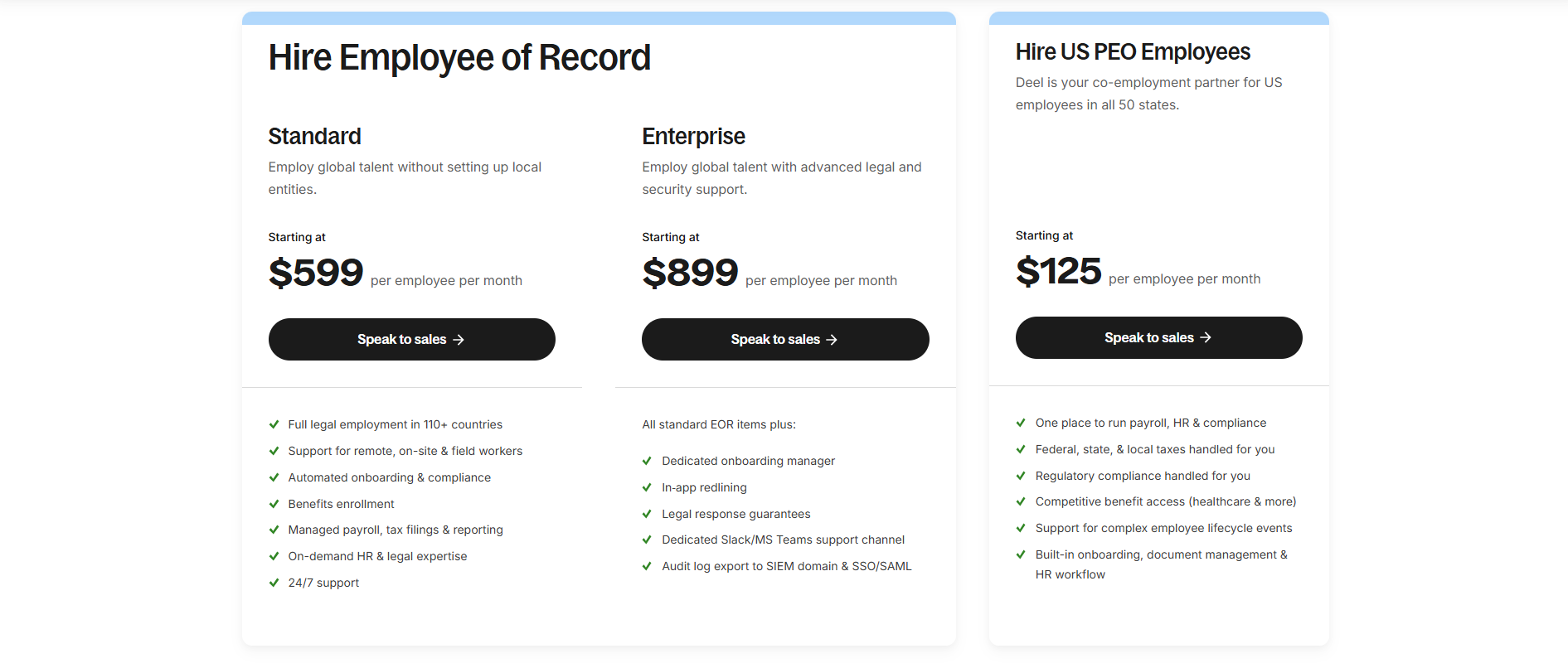
- EOR pricing per employee becomes significant
- Add-ons increase total cost
- Currency and transaction layers add complexity
For startups, this is acceptable.
For larger teams, it becomes a budget-level decision, not just a tool choice.
2. “All-in-One” Comes With Trade-Offs
Deel is evolving into a full workforce platform:
- Payroll
- HR
- Compliance
- Performance tools
- IT management
The issue?
👉 Not all modules are equally mature.
Compared to specialized tools:
- HR analytics may feel limited
- Performance tracking lacks depth
- Reporting can feel basic
So while Deel reduces tool fragmentation, it doesn’t always match best-in-class solutions in each category.
3. Complexity Increases With Scale
At small scale:
- Deel feels simple
- Workflows are clear
At larger scale:
- Country-specific rules stack up
- Payroll scenarios become complex
- Edge cases appear
This creates a learning curve.
Teams often need:
- Internal documentation
- Dedicated ops roles
- Deeper platform understanding
So while Deel simplifies global hiring, it introduces system complexity at scale.
4. Support Quality: Strong but Inconsistent
Deel’s support system is generally considered strong, especially for:
- Compliance-related questions
- Country-specific regulations
However:
- Response times can vary
- Complex issues may require escalation
- Resolution speed isn’t always predictable
This isn’t unusual for global platforms—but it’s something to factor in if your operations depend heavily on uptime and accuracy.
Deel vs Competitors: Market Positioning
To understand Deel properly, you have to see where it sits in the ecosystem.
Compared to Traditional Payroll Tools
Examples: ADP, Gusto
- Deel is more global
- Traditional tools are more localized
- Deel wins for international teams
Compared to Remote-First Platforms
Examples: Remote, Rippling
- Deel has stronger contractor support
- Competitors may offer deeper HR systems
- Pricing structures vary significantly
Key Differentiator
👉 Deel’s strongest advantage is still EOR accessibility at scale
Not just offering it—but making it usable without heavy legal involvement.
Who Should Use Deel (And Who Shouldn’t)
Ideal Users
Deel works best for:
- Remote-first startups
- Agencies with global freelancers
- SaaS companies scaling internationally
- Teams hiring across 3+ countries
For these users, Deel provides operational leverage.
Not Ideal For
Deel may not be the best fit if:
- You operate in a single country
- You only need basic payroll
- You require deep HR analytics
- Budget is highly constrained
In these cases, simpler or more specialized tools can be more efficient.
Strategic Insight: Deel as Infrastructure, Not Just Software
One mistake many people make is evaluating Deel like a typical SaaS tool.
That’s not the right lens.
👉 Deel is closer to infrastructure than software.
It replaces:
- Legal processes
- Financial systems
- Compliance workflows
This means:
- The value is high
- The cost is higher
- The dependency is deeper
Switching away from Deel isn’t just changing tools—it’s restructuring operations.
Final Assessment
Deel is one of the most important platforms in the remote work ecosystem—but it comes with trade-offs that become more visible at scale.
Strengths
- Rapid global hiring
- Strong compliance handling
- Flexible payment systems
- Excellent contractor management
Weaknesses
- Pricing escalates quickly
- Some features lack depth
- Complexity increases with scale
- Occasional support inconsistencies
Conclusion
If you’re building a globally distributed team, Deel can remove months of legal and operational friction.
But it’s not a “set and forget” solution.
You’ll still need:
- Process clarity
- Operational discipline
- Strategic oversight
Used correctly, Deel becomes a powerful backbone for international growth.
Used casually, it can feel expensive and occasionally overwhelming.