
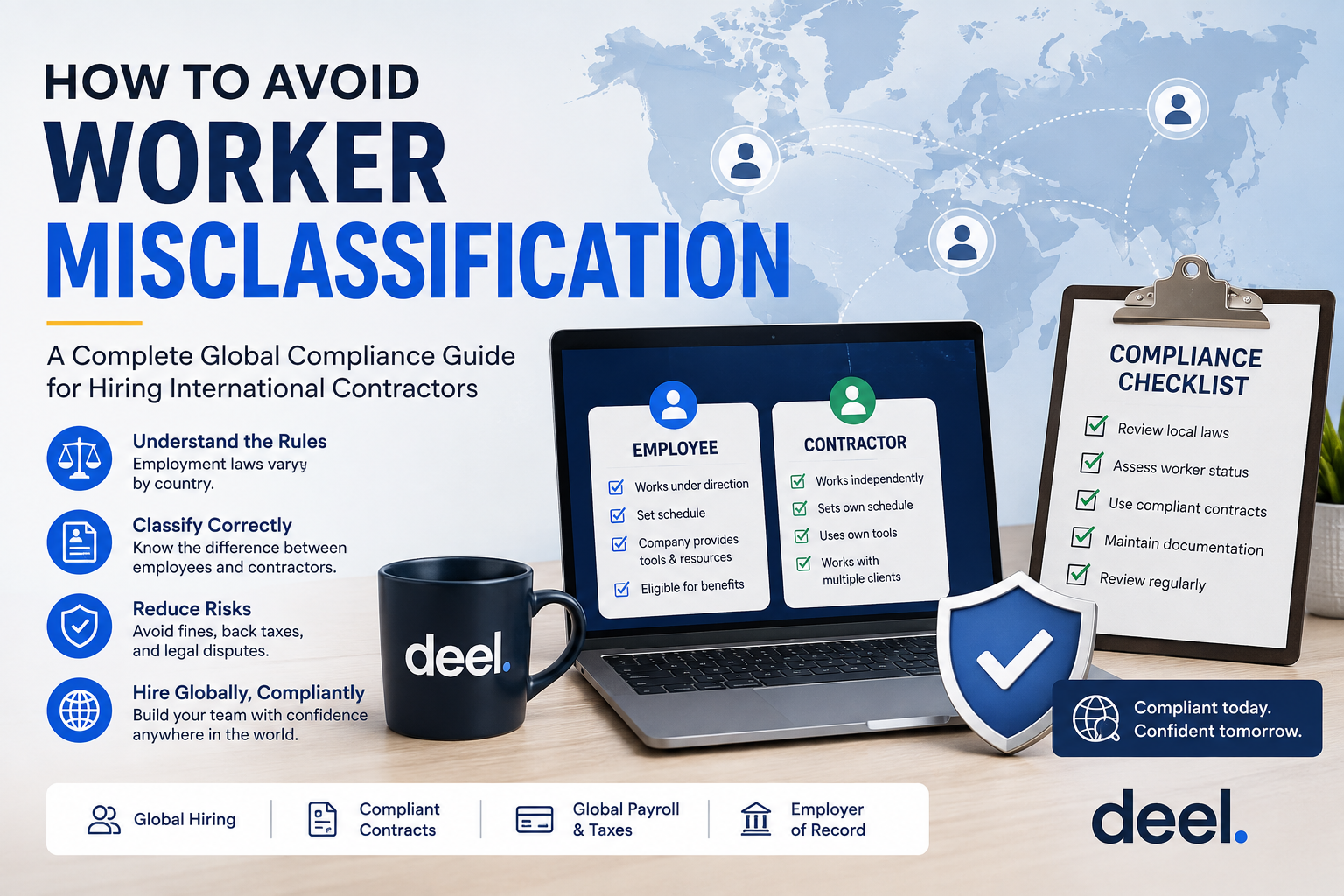

Global hiring has never been easier. Businesses of every size can now recruit talented professionals from virtually anywhere in the world, allowing them to build distributed teams, expand into new markets, and scale more quickly than ever before.
However, hiring internationally also introduces a significant compliance challenge that many companies overlook: worker misclassification.
Misclassifying a worker as an independent contractor instead of an employee is one of the most common compliance mistakes in global hiring. What may seem like a simple contractual arrangement can expose businesses to back taxes, government penalties, employee benefit claims, and legal disputes. Since every country applies its own employment laws, maintaining compliance becomes increasingly complex as organizations grow internationally.
This guide explains what worker misclassification is, why it happens, and the practical steps businesses can take to reduce compliance risks while hiring global talent.
What Is Worker Misclassification?
Worker misclassification occurs when a business treats someone as an independent contractor even though, under local employment laws, that individual should legally be classified as an employee.
The distinction matters because employees are generally entitled to legal protections and employer-funded benefits such as:
- Minimum wage protections
- Paid annual leave
- Sick leave
- Overtime compensation
- Social security contributions
- Pension or retirement benefits
- Termination protections
Independent contractors, on the other hand, typically operate as self-employed professionals. They control how they perform their work, often serve multiple clients, manage their own taxes, and generally do not receive employee benefits.
The challenge is that there is no universal definition of an independent contractor. Every jurisdiction evaluates employment relationships differently.
Why Businesses Get It Wrong
Most companies don’t intentionally violate employment laws. Instead, misclassification usually results from rapid growth, unfamiliarity with local regulations, or assumptions based on domestic hiring practices.
Some of the most common causes include:
- Expanding into countries without local HR or legal expertise
- Using the same contractor agreement worldwide
- Assuming a signed contractor contract guarantees compliance
- Managing contractors exactly like full-time employees
- Hiring quickly without reviewing local employment rules
Unfortunately, regulators examine the actual working relationship, not simply the title written in a contract.
The Real Cost of Misclassification
Many businesses choose contractor arrangements because they appear simpler and less expensive than hiring employees. However, if authorities determine that workers have been misclassified, the financial consequences can be substantial.
Potential liabilities include:
Back Taxes
Companies may become responsible for unpaid payroll taxes, employer social contributions, unemployment insurance, and other mandatory obligations.
Employee Benefits
Misclassified workers may claim benefits they should have received throughout their engagement, including paid leave, overtime, bonuses, healthcare contributions, pensions, and severance pay.
Government Penalties
Labor authorities in many countries actively investigate worker classification and may issue significant fines for non-compliance.
Legal Claims
Workers can pursue compensation for unpaid wages, denied benefits, or wrongful classification.
Reputational Damage
Compliance failures can damage employer reputation, making it harder to recruit top talent and expand into new markets.
How Governments Determine Employment Status
Although employment laws vary globally, regulators generally consider several common factors.
Degree of Control
Who decides when, where, and how work is completed?
Employees typically work under company supervision, while contractors maintain greater independence.
Financial Independence
Independent contractors usually:
- Invoice clients
- Set their own pricing
- Purchase their own equipment
- Cover business expenses
- Work with multiple customers
Employees generally rely on one employer for ongoing income.
Integration Into the Business
If someone is deeply integrated into day-to-day operations—using company systems, participating in internal management meetings, or performing core business functions—they may legally resemble an employee.
Duration of the Relationship
A contractor engaged continuously for several years, working exclusively for one company, may attract greater regulatory scrutiny.
Authorities rarely rely on a single factor. Instead, they evaluate the complete working relationship.
Warning Signs of Potential Misclassification
Businesses should periodically review contractor relationships for compliance risks.
Common warning signs include:
- Fixed working hours
- Daily supervision by managers
- Exclusive work for one company
- Company-provided equipment
- Paid vacation benefits
- Employee-style performance reviews
- Permanent organizational responsibilities
- Long-term, full-time engagements
The more these characteristics resemble traditional employment, the greater the risk.
Best Practices for Staying Compliant
1. Learn Local Employment Laws
Employment regulations differ significantly across countries. Before hiring internationally, understand the legal standards that apply where the worker resides.
2. Evaluate Every Engagement Individually
Avoid assuming every contractor relationship is the same. Review:
- Scope of work
- Level of independence
- Duration
- Reporting structure
- Business integration
3. Maintain Strong Documentation
Good documentation helps demonstrate compliance.
Keep records such as:
- Contractor agreements
- Statements of work
- Invoices
- Project deliverables
- Business correspondence
Documentation alone won’t determine employment status, but it provides important supporting evidence.
4. Conduct Regular Reviews
Contractor relationships often evolve.
Someone hired for a short project may gradually become embedded within the organization, increasing compliance risk over time.
Periodic reviews help identify issues before regulators do.
5. Train Managers
Managers should understand the legal distinction between contractors and employees. Treating contractors like permanent staff can unintentionally increase compliance risks.
How Deel Helps Reduce Misclassification Risk
Managing contractor compliance across multiple countries can quickly become overwhelming, particularly for growing companies without local legal teams.
This is where platforms like Deel provide practical support.
Deel helps businesses hire, onboard, and manage international contractors and employees while simplifying many of the administrative and compliance challenges involved in global hiring. Depending on the country and hiring model, Deel offers tools that assist with compliant contracts, localized onboarding, payroll management, tax documentation, and Employer of Record (EOR) services for companies that want to hire employees without establishing a local legal entity.
While no platform can eliminate every legal obligation, using a global employment platform can help businesses stay organized, follow local requirements more consistently, and reduce the likelihood of costly classification mistakes.
A Quick Compliance Checklist
Before hiring an international contractor, ask:
- Does the worker control how the work is completed?
- Can they provide services to multiple clients?
- Are they using their own equipment?
- Have local employment laws been reviewed?
- Is the written agreement consistent with the real working relationship?
- Is the engagement genuinely project-based?
- Have compliance risks been documented?
If several answers suggest an employment relationship, it’s worth reassessing the engagement before moving forward.
Final Thoughts
Global hiring creates tremendous opportunities, but it also requires careful attention to employment compliance.
Worker misclassification remains one of the biggest legal risks facing companies that hire internationally. The consequences can extend far beyond financial penalties, affecting employee trust, operational efficiency, and long-term business growth.
By understanding local employment laws, reviewing contractor relationships regularly, maintaining clear documentation, and using trusted global employment solutions like Deel where appropriate, businesses can significantly reduce compliance risks while building successful international teams.
Compliance should not be viewed as an obstacle to global hiring. Instead, it is the foundation that enables organizations to expand confidently, protect their workforce, and grow sustainably across borders.