

Hiring internationally opens up access to talented professionals, but managing employment contracts, local labor laws, payroll, and contractor payments across multiple countries can quickly become complicated.
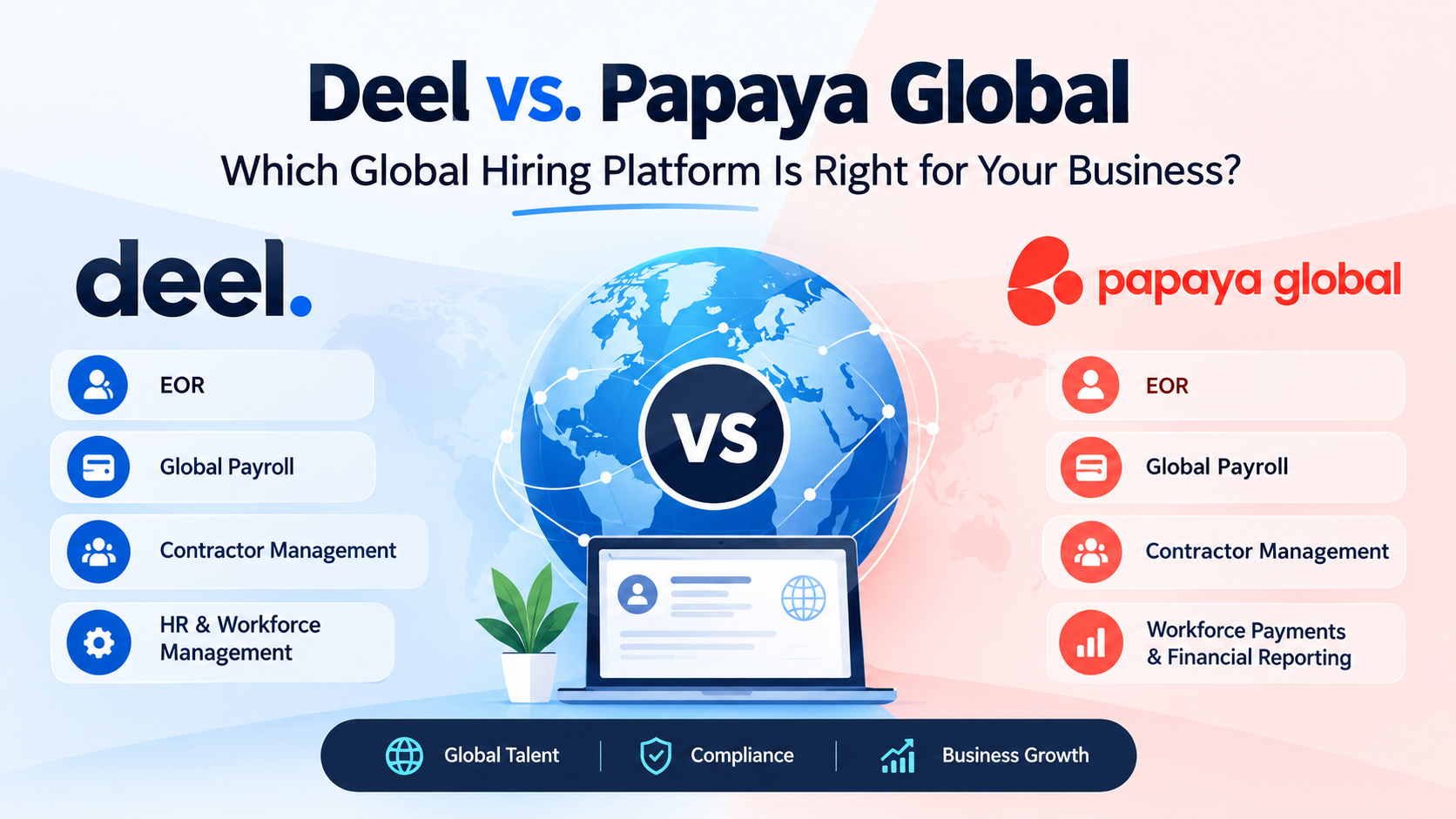
Two platforms that help businesses handle these challenges are Deel and Papaya Global. Both support international workforce operations, but their approaches and areas of emphasis differ.
Deel is my recommendation for companies that want an integrated platform for hiring international employees, managing contractors, and handling global HR operations as their workforce grows. Papaya Global deserves serious consideration for finance and payroll teams that prioritize centralized workforce payments, payroll administration, and financial reporting across multiple markets.
The right choice depends on what your company actually needs. A business hiring its first employee abroad has different requirements from an established multinational consolidating payroll across dozens of countries.
Let’s compare the two platforms in detail.
1. Deel vs. Papaya Global: Side-by-Side Comparison
| Feature | Deel | Papaya Global |
|---|---|---|
| Primary focus | Global employment, HR, payroll, and contractor management | Global payroll, workforce payments, and international employment services |
| Employer of Record (EOR) | Yes | Yes |
| Global payroll | Yes | Yes |
| Contractor management | Yes | Yes |
| Contractor of Record (COR) | Available | Available |
| International hiring | Hire employees in countries without establishing a local entity through EOR | International hiring through its employment services |
| Payroll operations | Integrated payroll capabilities, including in-house infrastructure in supported markets | Centralized payroll platform that can coordinate data from multiple markets and providers |
| Contractor payments | Multiple payment and withdrawal options, depending on location | International payment infrastructure and contractor payout capabilities |
| HR management | Broader HRIS and workforce management capabilities | Strong focus on payroll and workforce operations |
| Compliance support | Employment, payroll, and contractor compliance tools | Payroll, worker classification, and employment compliance capabilities |
| Best suited for | Companies managing different worker types across multiple countries | Companies prioritizing global payroll coordination and workforce payments |
Both providers cover important parts of international workforce management. The biggest difference is how well each platform aligns with your operating model.
Deel emphasizes a broad global employment and HR platform, while Papaya Global has a strong focus on payroll coordination and workforce payments. Neither should be selected based on a feature checklist alone; the implementation model and the countries involved matter just as much.
2. Understanding EOR, Global Payroll, and Contractor Management
Before choosing a provider, it is important to understand three services that are often grouped together but solve different problems.
Employer of Record (EOR)
An Employer of Record allows a business to employ someone in another country without establishing its own legal entity there.
The EOR becomes the worker’s legal employer for the employment arrangement, handling responsibilities such as locally compliant employment contracts, payroll administration, and applicable employment obligations. Your business generally continues to direct the employee’s day-to-day work, subject to the agreement and local law.
For example, imagine a US-based software company wants to hire a developer in Germany but does not have a German subsidiary. Using an EOR can provide a route to employment without requiring the company to establish that entity first.
Deel and Papaya Global both offer EOR services. When comparing them, investigate which legal entity will employ the worker, what local support is available, how benefits are administered, and who is responsible for particular compliance obligations.
An EOR arrangement does not eliminate every legal risk for the client company. The actual responsibilities depend on local law and the contractual structure.
Global Payroll
Global payroll is different from EOR.
It helps businesses calculate, administer, and coordinate payroll for employees across multiple countries. This can include salary calculations, deductions, tax withholding, statutory contributions, payroll reporting, and reconciliation.
A company that already has legal entities in several countries may need global payroll without needing an EOR. It wants to keep its existing employment structure while bringing payroll operations into a more consistent process.
This is an area where Papaya Global is particularly relevant for finance teams managing complex, multi-country payroll operations. Deel is also worth evaluating for businesses that want payroll capabilities integrated with international hiring and broader HR management.
The important question is whether the provider supports the company’s existing entities, payroll systems, reporting requirements, and local providers.
Contractor Management
Contractor management covers the process of engaging and paying independent professionals rather than employing them as employees.
Typical tasks include onboarding, contract administration, collecting tax information, invoice management, payment processing, and maintaining records.
For example, a marketing agency might work with independent designers in India, developers in Brazil, and consultants in the United Kingdom. A contractor management platform can help centralize these relationships instead of relying on separate spreadsheets and payment processes.
Both Deel and Papaya Global provide contractor management capabilities. Their pricing structures, payment methods, worker onboarding processes, and additional compliance services should be compared against your actual contractor population.
One critical distinction: contractor management is not the same as EOR employment. If a worker legally qualifies as an employee under the relevant country’s rules, simply signing an independent contractor agreement does not necessarily make the arrangement compliant. Businesses should assess worker classification before engagement and consider an EOR or another appropriate employment model when necessary.
3. Where Deel Has an Advantage
Deel is a strong option for companies that want to manage different types of international workers through a connected platform.
One platform for different workforce needs
A growing business may begin with freelancers, hire its first overseas employee, and later establish local entities with their own payroll requirements. Managing each stage with a different provider can create extra administrative work.
Deel brings together international hiring, EOR, contractor management, payroll, and broader HR capabilities. This makes it worth considering for companies that want to reduce the number of separate systems their people operations team must manage.
The benefit depends on which products your company purchases and how well they integrate with your existing tools.
In-house infrastructure in supported markets
Deel states that it operates its own global payroll infrastructure in more than 50 countries and owns the majority of the entities through which it provides services. This is a meaningful consideration for companies evaluating how much of their employment and payroll process is handled directly by the provider.
Ask each provider to identify its operating model in your priority countries. Direct operations, local entities, and third-party partners can affect implementation, communication, and how issues are escalated.
Broader HR management
Payroll is only one part of managing an international workforce. Businesses may also need onboarding workflows, time-off management, employee records, organizational reporting, performance management, and compensation planning.
Deel offers a broader set of HRIS and workforce management capabilities that may appeal to companies seeking to consolidate these activities.
For a company with a distributed workforce and a small HR team, having more of these functions available within one platform can reduce the need to coordinate information across disconnected tools.
Contractor payment flexibility
International contractors do not all use the same banking systems or prefer the same payment methods. Deel supports multiple contractor withdrawal options, although availability depends on the worker’s location and the method selected.
If contractor experience is important to your business, compare the available payout methods, currency conversion costs, settlement times, and fees in the actual countries where your contractors live.
4. Where Papaya Global May Be the Better Choice
A balanced comparison should also recognize situations where Papaya Global deserves to be on the shortlist.
Centralized multi-country payroll
Businesses with established legal entities and existing local payroll arrangements may need a platform that brings payroll information together across markets.
Papaya Global focuses on global payroll administration and workforce payments, making it relevant for multinational finance teams that want greater visibility into payroll costs and payment operations.
When assessing this capability, ask how the platform handles payroll data from existing providers, reconciles discrepancies, produces reports, and supports the finance team’s month-end close.
Workforce payment infrastructure
Papaya Global also emphasizes its payment infrastructure and international payment capabilities. For companies processing large volumes of workforce payments, payment visibility, reconciliation, foreign exchange, and predictable settlement can be important evaluation criteria.
Do not assume that a payment feature automatically makes one provider cheaper. Request a quote that includes transaction fees, foreign exchange costs, implementation, and any additional service charges.
Existing enterprise payroll processes
A large organization may already have an HRIS, established finance controls, and local payroll vendors. Replacing every system may be unnecessary or impractical.
In that situation, a platform that coordinates existing payroll processes may be a better fit than one chosen primarily for its wider HR functionality.
Papaya Global should therefore remain on the shortlist when the central project is payroll consolidation rather than rebuilding the company’s entire global employment stack.
5. Deel vs. Papaya Global Pricing
Pricing is an important part of the decision, but comparing headline prices without understanding the service scope can be misleading.
Both providers offer different services for different worker types, and the total cost depends on the countries involved, the number of workers, the required support, and the selected product.
When requesting quotes, compare these costs separately:
- EOR: Monthly charges per employed worker, onboarding fees, deposits, benefits, and any additional country-specific charges.
- Global payroll: Per-employee fees, implementation, local payroll services, off-cycle runs, and reporting requirements.
- Contractor management: Contractor fees, payment transaction costs, foreign exchange, and optional compliance services.
- Additional services: Benefits administration, immigration support, integrations, and other products your business actually needs.
Also consider the operational cost of maintaining separate systems. A cheaper service can become more expensive if it requires extensive manual reconciliation or additional software.
For a small company hiring a few overseas employees, an EOR quote may be the most relevant starting point. For a multinational with hundreds of employees across existing entities, payroll implementation and ongoing processing costs may matter more.
My advice: request comparable quotes from both providers using the same countries, worker counts, payment currencies, and service requirements. Confirm the contract terms and all applicable fees before making a decision.
6. Compliance and Customer Support
International workforce compliance is not a feature that should be evaluated solely through marketing claims.
Employment regulations, payroll taxes, social contributions, contractor classification, and data protection requirements vary by country. The quality of a provider’s local expertise and the clarity of its responsibilities can be more important than the number of countries listed on its website.
When evaluating Deel, ask about its local employment expertise, compliance alerts, support availability, and escalation process for country-specific questions.
When evaluating Papaya Global, investigate how it coordinates local payroll operations, supports compliance requirements, and resolves issues involving local providers or existing payroll systems.
For both providers, ask for a clear explanation of:
- Who handles employment contracts and statutory filings.
- How changes in local regulations are communicated.
- What happens when a payroll calculation or payment is incorrect.
- Which support channels are available and during what hours.
- What responsibilities remain with your own HR, finance, and legal teams.
Neither provider can guarantee that every workforce arrangement is compliant in every situation. Businesses should obtain qualified legal or tax advice when a decision depends on the interpretation of local law.
7. Which Should You Choose: Deel or Papaya Global?
There is no universal winner. The best platform depends on the problem you are trying to solve.
Choose Deel if:
- You need to hire employees internationally without establishing a local entity in every country.
- You manage a combination of employees and independent contractors.
- You want global hiring, payroll, and HR capabilities in a connected platform.
- You expect your international workforce to grow and need flexibility across different employment models.
- You value a broad set of contractor payment options and integrated workforce management tools.
Choose Papaya Global if:
- Your organization prioritizes centralized multi-country payroll administration.
- Your finance team needs better visibility into workforce payments and payroll reconciliation.
- You already operate legal entities and want to coordinate existing payroll processes.
- You need to evaluate payment infrastructure and financial reporting alongside employment services.
- Your main project is consolidating global payroll rather than adopting a broader HR platform.
My final verdict
For a growing company that needs to hire internationally, manage contractors, and support employees across multiple countries, I would start with Deel. Its combination of EOR, contractor management, global payroll, and broader HR capabilities makes it a compelling option when workforce needs extend beyond payroll processing.
For a large organization whose primary challenge is coordinating payroll and workforce payments across established entities, Papaya Global may be the more appropriate choice to evaluate first.
Before signing either contract, test the provider against your actual hiring countries, worker classifications, payroll requirements, integrations, and total costs. A successful implementation depends on choosing the right operating model—not simply the platform with the longest feature list.
Deel may be a better fit for businesses that want integrated international hiring, contractor management, and broader HR capabilities. Papaya Global may be more suitable for companies focused on centralized multi-country payroll and workforce payments. The better option depends on your company’s needs.
Yes. Both providers offer Employer of Record services. An EOR can employ workers in supported countries on behalf of a client company that does not have its own local entity. Country availability, employment arrangements, benefits, and service terms should be confirmed directly with the provider.
EOR allows a company to employ someone in another country through a provider acting as the legal employer. Global payroll helps administer payroll for employees, often within entities the company already owns. A business may need one service or both, depending on its structure.
Both offer contractor management and payment capabilities. Available payment methods, currencies, fees, and compliance services vary. Compare the specific arrangements available for the countries where your contractors are based.
A small business hiring its first international employee or working with contractors may find Deel’s combination of employment and workforce management capabilities useful. However, the decision should depend on the number of workers, target countries, budget, and services required. Request a quote before committing.
Start by listing your target countries, worker types, headcount, payroll structure, and required integrations. Then request quotes using the same assumptions and compare implementation, ongoing costs, local support, compliance responsibilities, and contract terms.
Explore Deel for Your Global Hiring Needs
If you want to manage international employees and contractors while bringing more of your global workforce operations together, explore Deel’s available services and see whether they match your business requirements.
Review the features and terms for your target countries, then request a tailored demonstration if you need to assess the platform against your existing workflow.